Presentación
CYBEREDUCA
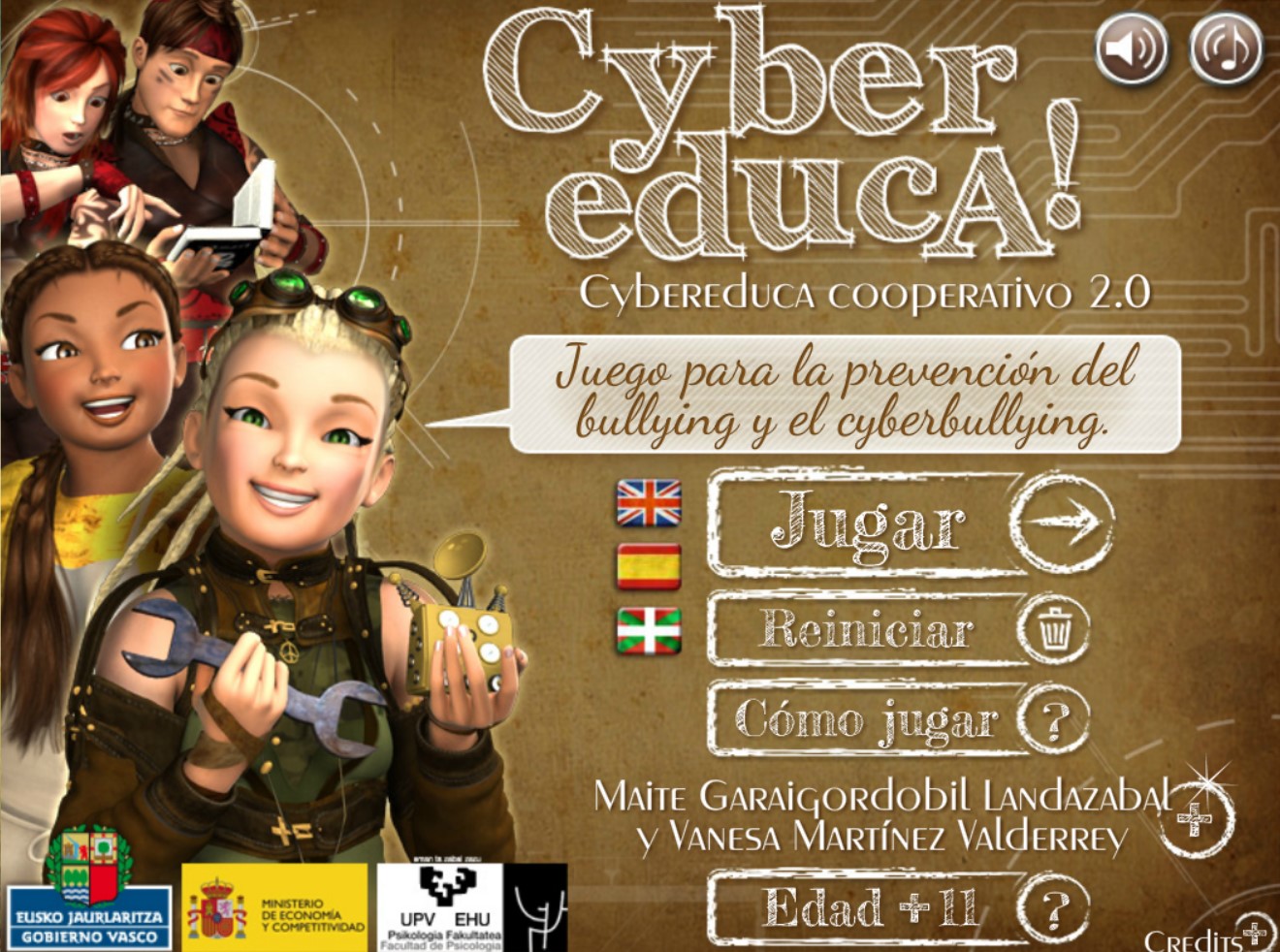
To complement and reinforce the effects of Cyberprogram 2.0, an intervention program to prevent and reduce cyberbullying (Editorial Pirámide 2014), a video game "Cybereduca Cooperative 2.0. Game for the prevention of bullying and cyberbullying (Garaigordobil and Martínez, 2016)" has been created, which can be found at the following web address: http://www.cybereduca.com/. Ages, Access, and Playing Contexts The video game is free to access for all users from the age of 11 who wish to play and has the general purpose of preventing bullying and cyberbullying by increasing protective factors and decreasing risk factors. The video game is designed to be played in teams and with an adult who guides the development of the game and encourages reflection, although it can also be played independently by the adolescents and young people to whom it is addressed, and in individual mode. The game can be implemented in a variety of contexts: in schools playing with the whole class-group with the guidance of the teacher, in free-time groups, in the family context playing parents and children...
Characteristics of the Video Game: Cooperative, Constructive, and Non-Sexist.
Cybereduca 2.0 is a cooperative, non-competitive game. Cooperative games promote communication, increase prosocial behaviors, enhance group cohesion, and improve the concept of oneself and others. Cybereduca 2.0 is a constructive game, in the literal sense. The characters are guilds of builders whose objective is to use their cooperative skills to rebuild fantasy worlds. The guilds of Cybereduca 2.0 do not wield weapons, but tools, and do not fight battles, but cooperate with each other to achieve their joint goals and thus restore peace and coexistence. Cybereduca 2.0 is a non-sexist game that presents female and male characters equally, distributed equitably throughout the game. Collective guilds are represented by a team of girl and boy. Both members of the team have a similar physical and psychological profile, not differentiated by gender, and share the same wardrobe without any variation. Unitary guilds are represented by an androgynous character, or a non-stereotyped female.Video Game Dynamics and Represented Roles
The game begins with the destruction of the world in which the guilds are located, representing five different roles involved in a bullying/cyberbullying situation: (1) Aggressors (guild of the skull stonecutters: tough guys, play heavy jokes on others, insensitive...); (2) Victims (guild of the solitary painters: sensitive, object of jokes from the skull stonecutters, solitary...); (3) Observers who defend the victims (guild of the justice engineers: usually get along well with everyone, but do not tolerate injustices, if someone is acting badly, they tell them to their face...); (4) Observers who support the aggressors (guild of the giggling carpenters: 2 sociable and fun, they like to be part of the group, they don't usually make jokes, but they laugh if others do); and (5) Passive observers who do not intervene (guild of the impassive plumbers: they are good guys, but they mind their own business, they don't mess with anyone, but they stay out of the problems and thus don't get splashed). The guilds (players/teams) must complete challenges (open doors, free disappeared characters...) and rebuild worlds (booty bay, gadget village, dragon's nest, high flight, and Zhantia city). To this end, they must cooperate by answering questions. The complete game contains 120 questions that revolve around 5 themes or thematic categories (24 per theme), and 24 complementary cards that require identifying emotions and cooperatively dramatizing fun and prosocial behaviors.
Video Game Themes: Cyberphenomena, Security, Cybersexuality, Consequences, and Coping with Bullying/Cyberbullying The questions on the video game cards that the players must answer revolve around 5 thematic categories:
Theme 1. Cyberphenomena and Harassment: In this theme, the contents of the questions help to identify and define what bullying, cyberbullying, and other cyberphenomena related to the use of mobile phones, the internet... are, with the use of ICTs, such as grooming, nomophobia, cyberbaiting, flaming, griefing, trolling, outing, cyberstaking, phising...
Theme 2. Computing and Security: The questions contained in this theme, on the one hand, help to clarify computer concepts (firewall, cookie, blogger, antivirus, router, spam, anti-pop-up programs...), and, on the other hand, provide data on protection standards and safe use of Information and Communication Technologies (ICT) (mobile phone, internet...), as well as on risky behaviors and ethical standards of conduct in social networks.
Theme 3. Cybersexuality:The questions associated with this theme, on the one hand, help to identify, prevent and cope with sexting and, on the other hand, allow reflection on various sexual behaviors that are carried out using ICTs and that have very negative consequences such as sextortion, grooming, sexual abuse...
Theme 4. Consequences of Bullying and Cyberbullying: In this theme, the contents of the questions allow identifying the consequences of face-to-face and electronic harassment on the victims, the aggressors, and the observers (emotional, social, intellectual effects...), promoting the development of empathy towards the victims.
Theme 5. Coping with Bullying and Cyberbullying: This theme presents problematic situations showing appropriate behaviors to cope with situations of bullying, cyberbullying, and other phenomena associated with the use of ICTs, from the perspective of the victims, the observers, and the aggressors.
The dramatization actions promote that the players represent positive and negative emotions (sadness, happiness, anger, fear...), and also encourage performing prosocial actions in which the players have to cooperate with the other members of their team to perform a positive action (give a hug, applaud, sing a song...). In the dynamics of this game, the teams answer questions that allow them to open doors, free characters from the video game, and rebuild worlds, always with the cooperation of all the players. The game is won 3 when everyone achieves the objectives after answering the questions and rebuilding the worlds through cooperative construction actions.
Objectives of Cybereduca Cooperative 2.0:
Fun and Learning The video game has two main objectives, firstly, pleasure since we hope that the players of this video game have fun and enjoy it, and secondly, that the playful experience has a bullying/cyberbullying prevention effect, helping players to: (1) become aware of various phenomena that occur in cyberspace, their implications and consequences; (2) learn computer security behaviors; (3) understand the effects of sexual behaviors through ICTs; (4) identify the serious consequences of bullying and cyberbullying for all those involved (victims, aggressors, observers); and (5) develop positive strategies for coping with harassment in all its forms that allow to identify, denounce and eradicate these harmful behaviors.
To conclude, I would like to thank the organizations that have financed the development of this work, the Ministry of Economy and Competitiveness (MINECO, PSI2012-30956), the Basque Government (IT638-13, M-122-DEPS2015) and the University of the Basque Country (UFIPSIXXI-11/04) since thanks to their support it has been able to develop this video game and is now freely accessible to all users who wish to use this antibullying tool in the world since it can be played in Spanish, Basque and English.